
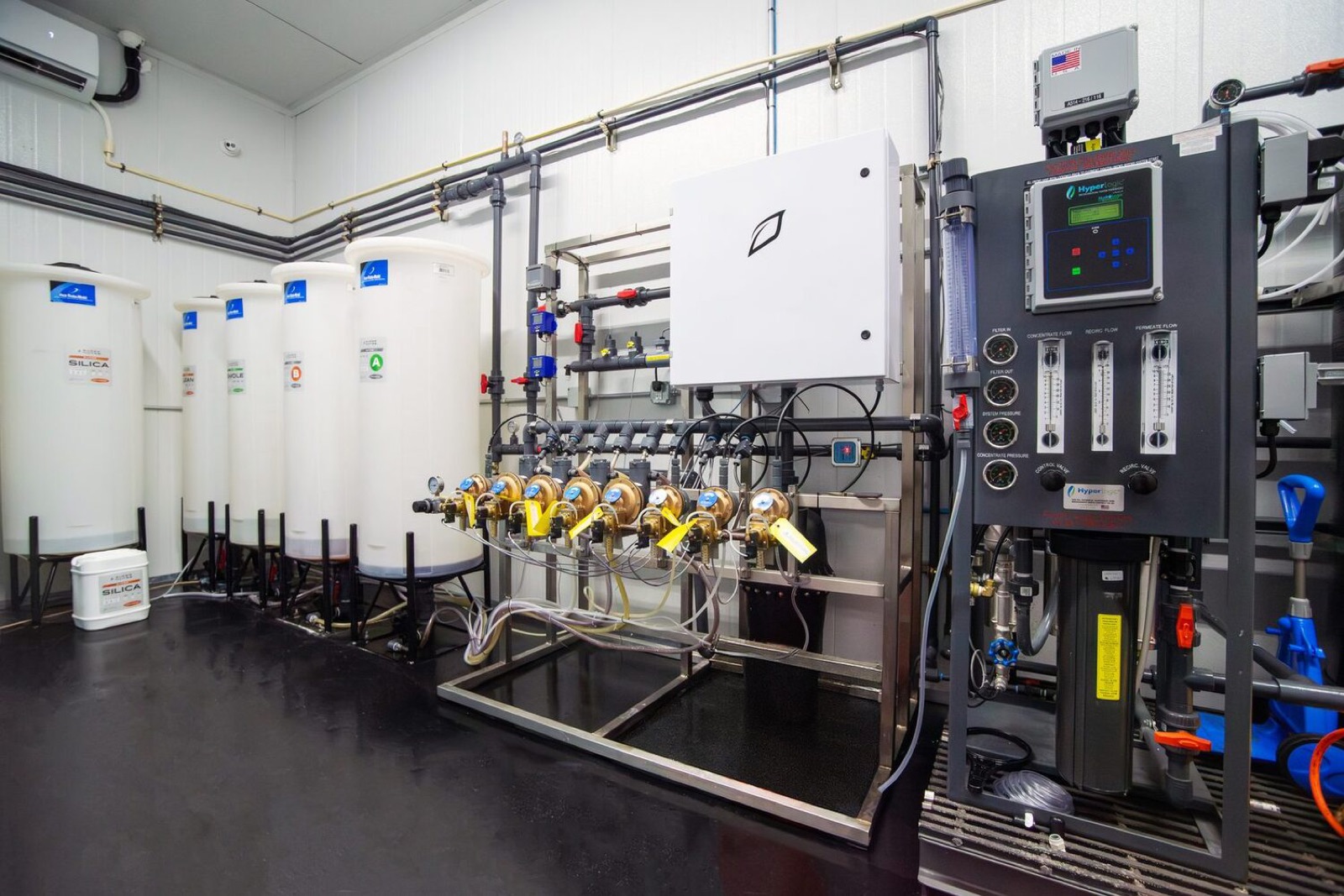
Croptober is over. The flower is hanging or in the jar, and the rooms that grew it are empty for the first time in months. The gap before restock is short. Don’t spend it catching up on everything else. The days a room sits empty are the only days you can reach every surface, every coil and every emitter at once.
Good grow room cleaning between harvests is not a single wipe-down. It is a sequence, and the order matters. Done properly, it resets the pest and pathogen load, puts instruments back in calibration and gives the next run a clean baseline. Rushed, it carries last cycle’s problems straight forward.
The sanitation sequence: dry, wash, sanitize, then air
University greenhouse sanitation guides agree: disinfectants work on clean surfaces. Soil, media and plant debris protect pathogens from contact with the product, so spraying a dirty room mostly sanitizes the dirt. The order follows from that.
- Dry clean first. Pull every plant, root ball, leaf, spent bag and slab of media. Sweep and vacuum floors, trench drains, bench tops and the tops of ducting.
- Wash. Detergent and water on walls, floors, benches, trellis posts and carts. Scrub dried residue, then rinse.
- Sanitize. Apply a sanitizer labeled for the surface and the use, at label rate and contact time. Contact time is the part that gets cut short. A surface that dries in thirty seconds has not had a ten-minute dwell.
- Treat the air and what you can’t reach. Ceilings, the backs of fixtures and the inside of ductwork never get the same attention as the floor.
Check that every product you use is allowed under your state program before it touches a cultivation room. That rule applies to sanitizers as much as to anything sprayed on plants.
HLVd and pests: test before you restock
Hop latent viroid moves in sap: on blades, gloves, hands and anything else that touches one plant and then the next. A 2025 review in Plants found the viroid stayed detectable in dried leaves and roots for up to four weeks at room temperature, and on utensils like watering cans. In the same work, only 10% bleach for two minutes, 20% bleach, or 1,000 ppm hypochlorous acid fully degraded HLVd RNA in infected sap. Many common sanitizers did not.
So debris left behind is a real reservoir. And the room is only half the problem; the other half is what you bring in. The same review notes that roots are a more reliable sample than leaves, because the viroid is spread through root tissue more evenly. If you run your own mothers, test them on a schedule and pull positives before they become cuttings. If you buy in starts, ask how they were tested.
Pests follow the same logic. Sticky cards in the empty room for a few days after sanitizing show what survived. Inspect incoming starts under magnification before they cross the door. Our earlier posts on HLVd biosecurity and clean-room IPM go further into both.
Clean starts in clean media
Propagation is where a new run either starts clean or doesn’t. Fresh media, sanitized trays and domes, blades disinfected between mothers. iHort’s 40/40 Q Plug and T50 Excel Plug Tray are stabilized plugs that hold their shape and drop straight into standard trays and domes, so there is no loose mix to spill and carry around the prop room.
Recalibrate everything that gives you a number
An empty room is the only time nobody minds a sensor being offline. Use it.
- pH probes. Two-point calibration at minimum, pH 7 first and then pH 4, with fresh buffer and a rinse in between. If the meter won’t hold calibration or reads slowly, the probe is done. Store it in probe storage solution, never dry and never in distilled water.
- EC probes. Clean the cell, then check against a fresh calibration standard. Replace the standard when it is old or open.
- Inline dosing and substrate sensors. Pull them, clean them, and check them against a handheld you just calibrated.
- Climate sensors. Put a reference instrument next to each temperature, humidity and CO₂ sensor and record the gap. A sensor reading two points of RH high runs your dehumidifiers on a false number all cycle.
HVAC, dehumidifiers, drains and filters
Late flower and harvest put the heaviest moisture load of the year through your coils. Open the access panels and look. Dirty evaporator coils cut capacity and grow things. Check and clear condensate pans and drain lines. A slow drain in November is an overflow in March. Replace filters rather than vacuuming them, and note the date. Units with service access panels, like Altaqua’s HVACD systems, make this a routine job rather than a project.
Flush irrigation and check every emitter
Lines that ran nutrient solution all cycle carry biofilm and mineral scale. Flush mains and laterals with a line cleaner labeled for irrigation systems, then clean water. Clean or replace filters and screens on the injector side. Then run the system and check emitters. Catch output from a sample of drippers across each zone, and look at the spread. Weak emitters show up as uneven plants in week three. Our post on irrigation uniformity covers how to measure it.
Clean and inspect the lights
Dust on lenses and diodes cuts light at the canopy. With power isolated, wipe them down following the manufacturer’s guidance on cleaning products. Check cords, connectors and driver housings for heat damage or corrosion. If you have a PAR meter, map the empty room at canopy height for a baseline.
Turn the downtime into data
The last cycle left a record. Pull it while the room is empty and the run is still fresh. Where did humidity spike, and at what time of night? Which zone ran warm? Did the dehumidifiers run flat out for weeks at a stretch? Did runoff EC drift in one section? Some of what you find gets fixed in this turnover. The rest becomes the list for next year’s budget, which is where the rest of this month’s posts pick up.
FAQ
How long should a cannabis room turnover take?
Long enough to finish the sequence and respect sanitizer contact and dry times. The limit is whether every step was finished, not the calendar.
Can I skip the wash and just sanitize?
No. Organic residue protects pathogens from the sanitizer.
Does room sanitation get rid of HLVd?
It removes reservoirs on surfaces, tools and debris. It does nothing for an infected plant. Infected mothers or clones bring HLVd back in, so testing starts is just as important.
How often should pH and EC meters be calibrated?
Follow the manufacturer’s schedule. At minimum, do a full calibration and probe check before every new run.
Planning a build or an upgrade?
Hydro Supply Co. supplies commercial cultivators nationwide — lighting, climate, irrigation, nutrients and post-harvest, from one source.
Request a Quote