
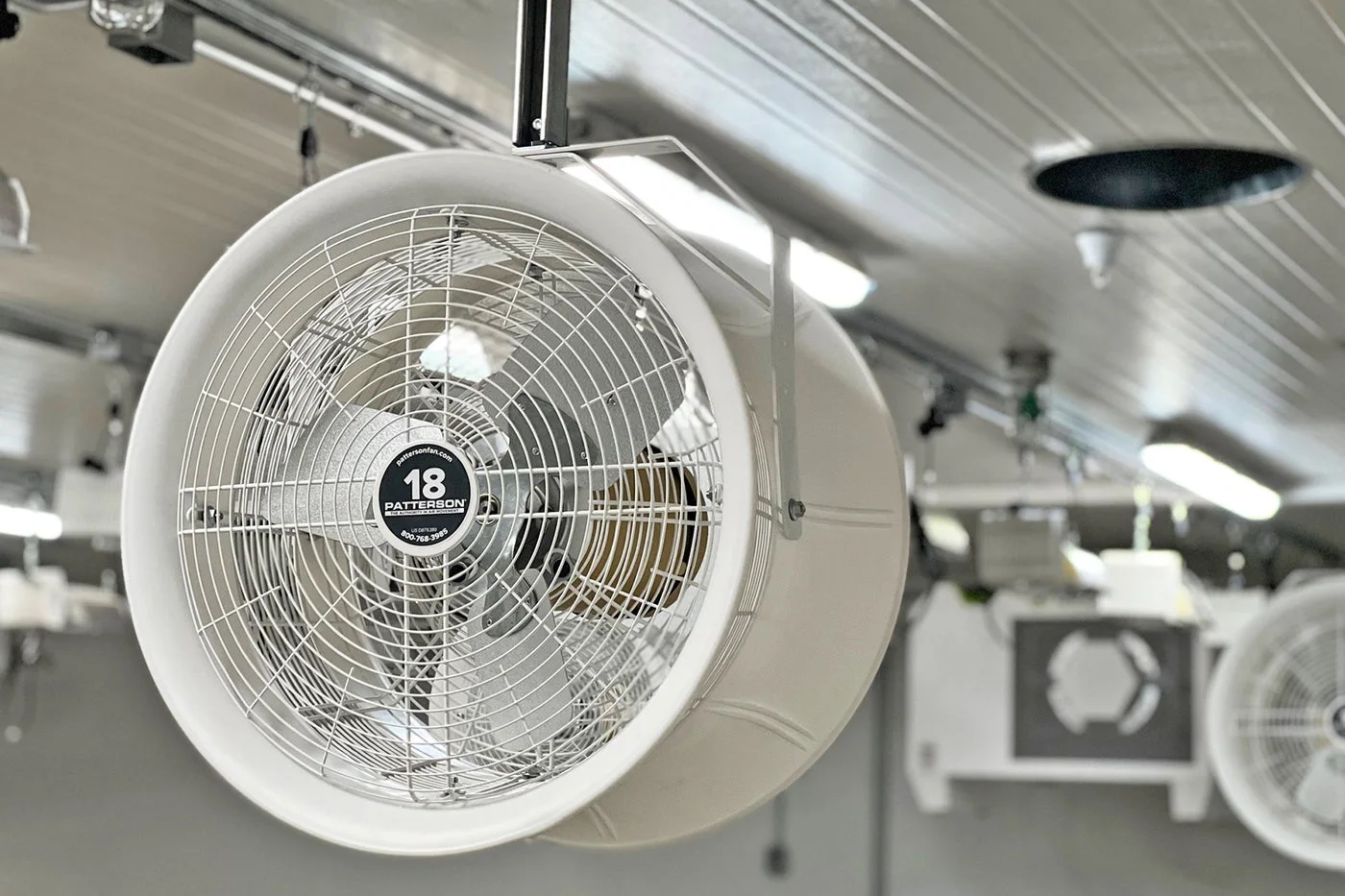
How many fans does a grow room need? It's one of the most consistently under-engineered decisions in commercial cannabis facility design. Head growers frequently inherit rooms spec'd on gut feel — a handful of fans placed near the walls, running at full speed from clone through flush — and spend the rest of the cycle chasing microclimate hot spots, uneven VPD readings across the canopy, and late-flower botrytis pressure that dehumidification alone can't solve. This guide gives cultivation directors and facility engineers a structured, numbers-first method for sizing horizontal airflow (HAF) fans in a commercial flower room, starting from the plant-science rationale, moving through the coverage-per-fan calculation, adjusting for racking and dense canopy, and ending with control strategy across the crop cycle.
Why Air Movement Matters: Boundary Layer, VPD, and Disease Risk
Every leaf sits inside a thin layer of still air called the boundary layer. When that layer isn't disturbed, CO₂ reaches the stomata more slowly and humidity right at the leaf surface climbs above the room reading. Steady air movement across the canopy keeps thinning it. The goal is a gentle, continuous breeze through the whole canopy: enough to keep the leaves and colas drying, not so much that leaves are flapping or flowers are being pushed around.
VPD uniformity follows from good circulation. A room-level VPD target only means something if the air is mixed; in stratified air the lower canopy and the room interior can run at a very different VPD than the sensor on the wall. Circulation fans collapse that gradient so the reading reflects what every plant is actually seeing. For stage-by-stage targets, see our guide to VPD control in the grow room.
The disease risk is concrete. Dense flowers trap moisture, and without airflow humidity pockets form around each cola: the conditions Botrytis cinerea (bud rot) and powdery mildew need in late flower. Still air also lets spores settle on leaf surfaces instead of being carried to filtration. Our bud rot and late-flower dehumidification guide covers the moisture side of the problem.
There is a secondary agronomic benefit worth quantifying: thigmomorphogenesis. Consistent gentle airflow triggers a mechanical-stress response in which stems deposit additional lignin and develop thicker cell walls. This structural reinforcement matters commercially — self-supporting stems reduce trellis-repair labor and decrease the risk of heavy, resin-laden colas toppling and creating internal wound sites that Botrytis exploits. EC variable-speed fans make this easier to manage: run lower RPM during early veg to produce a gentle, consistent breeze, then ramp output as canopy density increases through flower.
The Coverage-Per-Fan Method: How Many Fans Does a Grow Room Need?
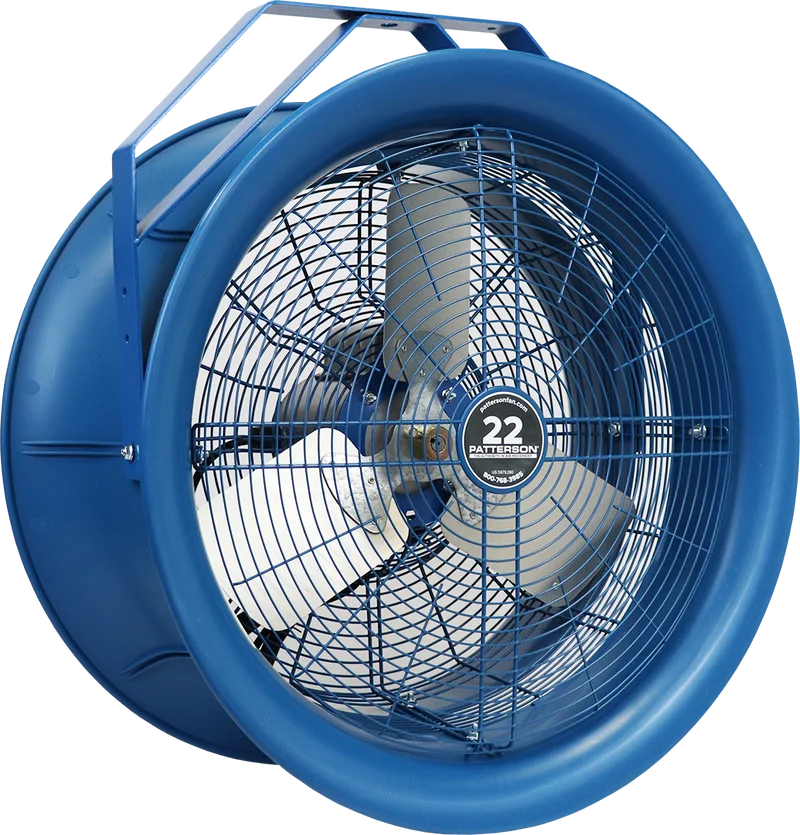
Patterson publishes a rated coverage area for each high-velocity fan. That is the most practical starting point for a commercial room, because it already reflects the fan's CFM and throw. The method:
- Step 1, pick a size by throw: choose a fan whose rated throw reaches the length of the room (or half of it, if you'll run a racetrack on both walls).
- Step 2, baseline count: floor area (sq ft) ÷ that fan's rated coverage, rounded up.
- Step 3, adjust upward for racking tiers, walls and columns, and dense late-flower canopy that block airflow.
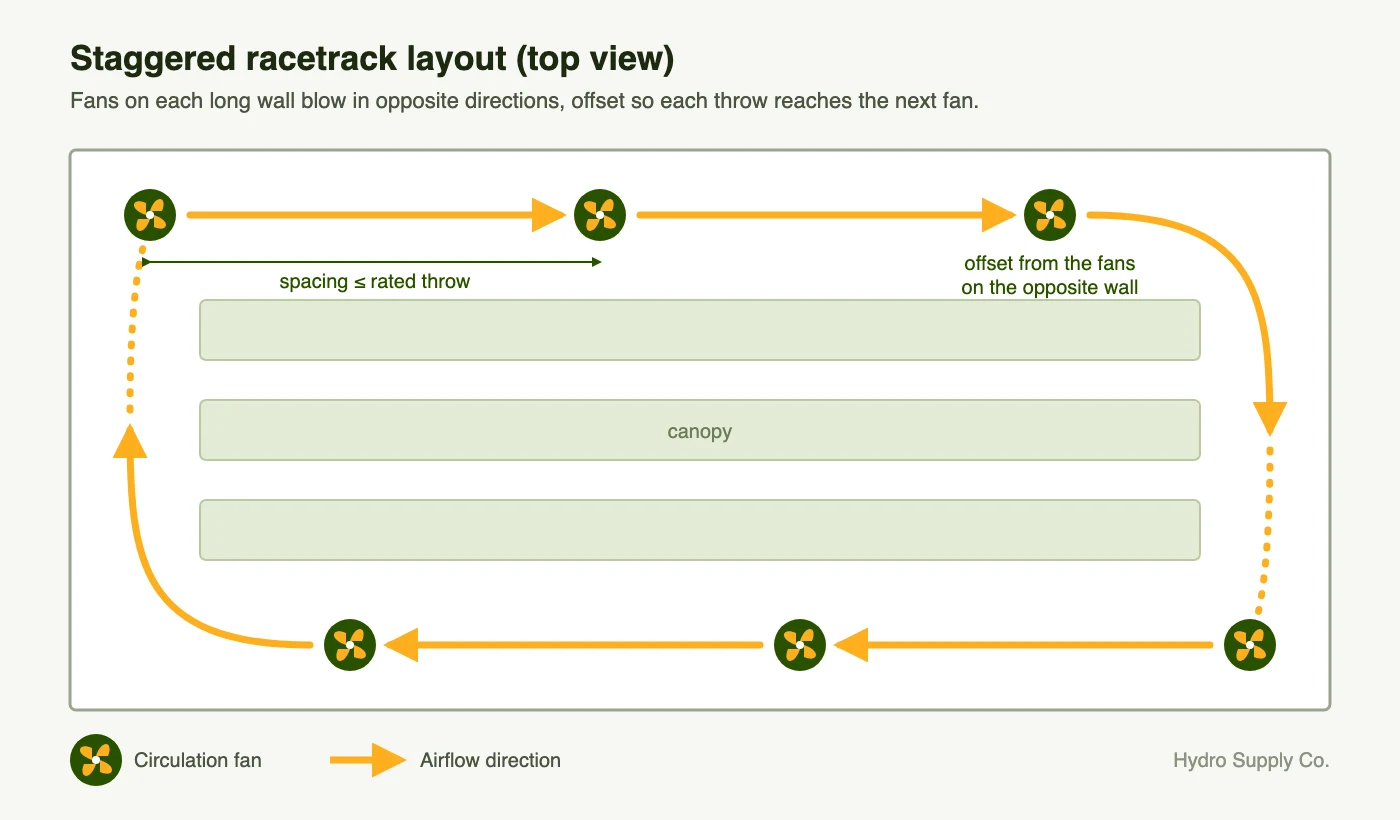
- Step 4, lay out the loop: place fans so each throw reaches the next fan, forming a continuous loop rather than opposing streams.
- Step 5, validate with a smoke test and an anemometer at several canopy points.
The Patterson high-velocity fan line has five sizes with published CFM, throw and coverage ratings. The table shows baseline counts for common footprints, before any adjustment for racking or canopy.
The 14" and 18" fans cover most single flower rooms with two or three units. The 26" and 30" use 1 HP inverter-duty motors built for VFD control and suit large halls and greenhouses, where throw distance rather than coverage is usually the limit. The 22" is the largest size offered in single-phase, corded form.
Adjusting for Racking, Walls, and Dense Canopy
The baseline count from Step 3 assumes a single-tier, open floor layout with clear sightlines. Commercial flower rooms are rarely that simple. Three conditions require upward adjustment:
Vertical Multi-Tier Racking
Vertical racking multiplies canopy area without multiplying floor area. A two-tier rack in a 4,000 sq ft room has effectively 8,000 sq ft of canopy to serve. Horizontal airflow fans mounted at room perimeter cannot reliably penetrate all the way through a fully-loaded bottom tier; the upper tier gets good airflow while the lower tier stagnates. The correct approach: add at least one supplemental fan per tier per rack row, or use rack-mounted fans on each level directed down the aisle between rack faces. Patterson's rack mounts hang a fan from pallet racking or shelving for exactly this; see the EC variable-speed fans for rack-level fans whose speed you can turn down. Validate with an anemometer or smoke test at each tier level.
Wall Obstructions and Room Shape
HAF efficiency relies on air moving in a coherent racetrack loop — once set in motion, it coasts with minimal energy input. Obstructions that break the loop (columns, HVAC drops, ductwork runs, room L-shapes) dissipate momentum and create dead zones, typically in corners and behind structural elements. For each significant obstruction, add one fan positioned to re-inject momentum into the disrupted zone. Irregular room shapes (L, U, or multi-bay) should be treated as separate rectangular sub-rooms, each requiring its own fan circuit.
Dense Late-Flower Canopy
Open-canopy crops — some greenhouse vegetable species, for example — allow HAF air to travel relatively unimpeded at rated throw distance. Cannabis in weeks 6–9 of flower is a different environment entirely. Dense interior foliage attenuates airspeed significantly before it reaches the interior of the canopy. Plants with thick leaf cover that limits airflow through the interior are at elevated PM risk specifically because of that internal stagnation. Plan extra fans over the baseline for rooms that run at full canopy density through late flower, or reduce fan-to-fan spacing so throw distances overlap rather than just meet.
Throw Distance vs. Room Length: The Check That Overrides CFM Math
Total CFM tells you whether you have enough air-moving capacity for the volume. Throw distance tells you whether that capacity can actually reach every part of the room. These are independent constraints, and both must be satisfied. For a room longer than a single fan's rated throw, the standard HAF solution is a staggered opposite-wall racetrack pattern: fans on the north wall point south, fans on the south wall point north, offset by half the fan spacing so their throw zones overlap at mid-room. This creates a coherent loop rather than two opposing air streams that cancel each other.
Dense canopy shortens the distance a fan's air stays useful. Rated throw is measured in open air; through a closed cannabis canopy, plan for fans to overlap rather than just meet, and tighten fan-to-fan spacing until smoke stops pooling anywhere in the room.
Fan Control Strategy Across the Crop Cycle: Fixed-Speed, EC Variable-Speed, and VFD
Fan count is only part of the equation. How fans are controlled across the crop cycle determines whether your sizing translates to actual plant-level results — and whether you capture the energy savings available from variable-speed technology.
Fixed-Speed Fans
Fixed-speed fans are straightforward to install and maintain. The limitation is binary operation: fans are either fully on or fully off. For operators who want constant circulation without environmental integration, this is acceptable. The trade-off is that a single speed setting optimized for late-flower density will be too aggressive for early veg — potentially causing stem stress or unnecessary energy draw — and a setting optimized for veg will be insufficient once canopy closes in flower. Fixed-speed fans also cannot participate in environmental control loops.
EC Variable-Speed Fans (300–1,800 RPM)
The Patterson EC variable-speed fans (14", 18" and 22") run from 300 to 1,800 RPM on one electronically commutated motor that auto-adapts to any single-phase supply from 115V to 277V. Speed is set from a dial or from a climate controller over 0–10 VDC, 4–20 mA, PWM or MODBUS. That suits most commercial flower rooms: run lower speed for young plants, step up as the canopy closes, and run full speed through late flower. With a controller signal, fan speed can also rise automatically when RH spikes, such as after irrigation and at the lights-off transition.
VFD-Ready Fans for Large Footprints
The Patterson 26" and 30" models carry 1 HP inverter-duty motors rated for VFD control. VFD (variable frequency drive) integration is the preferred solution for large single-bay operations where fans are permanently wired into the facility electrical system and climate control is centralized. VFD systems allow smooth ramping rather than stepped speed changes, reduce inrush current on startup (extending motor lifespan), and can integrate with building automation systems for zone-level control. Turning fans down also saves energy: by the fan affinity laws, power falls roughly with the cube of speed, so a fan at 70% speed draws around a third of its full-speed power.
Specialty Mounting and Small-Space Applications
Not every airflow challenge in a commercial facility maps to a large HAF fan. The Patterson F10A 10" two-speed fan (115V, ~40 ft throw) fills a specific and important role: dry-room corners where a full-size HAF fan would overpower a small space, trim station workbenches, and short rack aisle sections where a 14" unit would be physically oversized for the mounting point. Yoke mount is standard across the line; rack-mount brackets are available for pallet racking and shelving installations; beam clamp hardware handles truss mounting in facilities with exposed structural steel.
HAF Fan Placement Patterns for Commercial Flower Rooms
Placement is as important as count. The following patterns cover the most common commercial configurations:
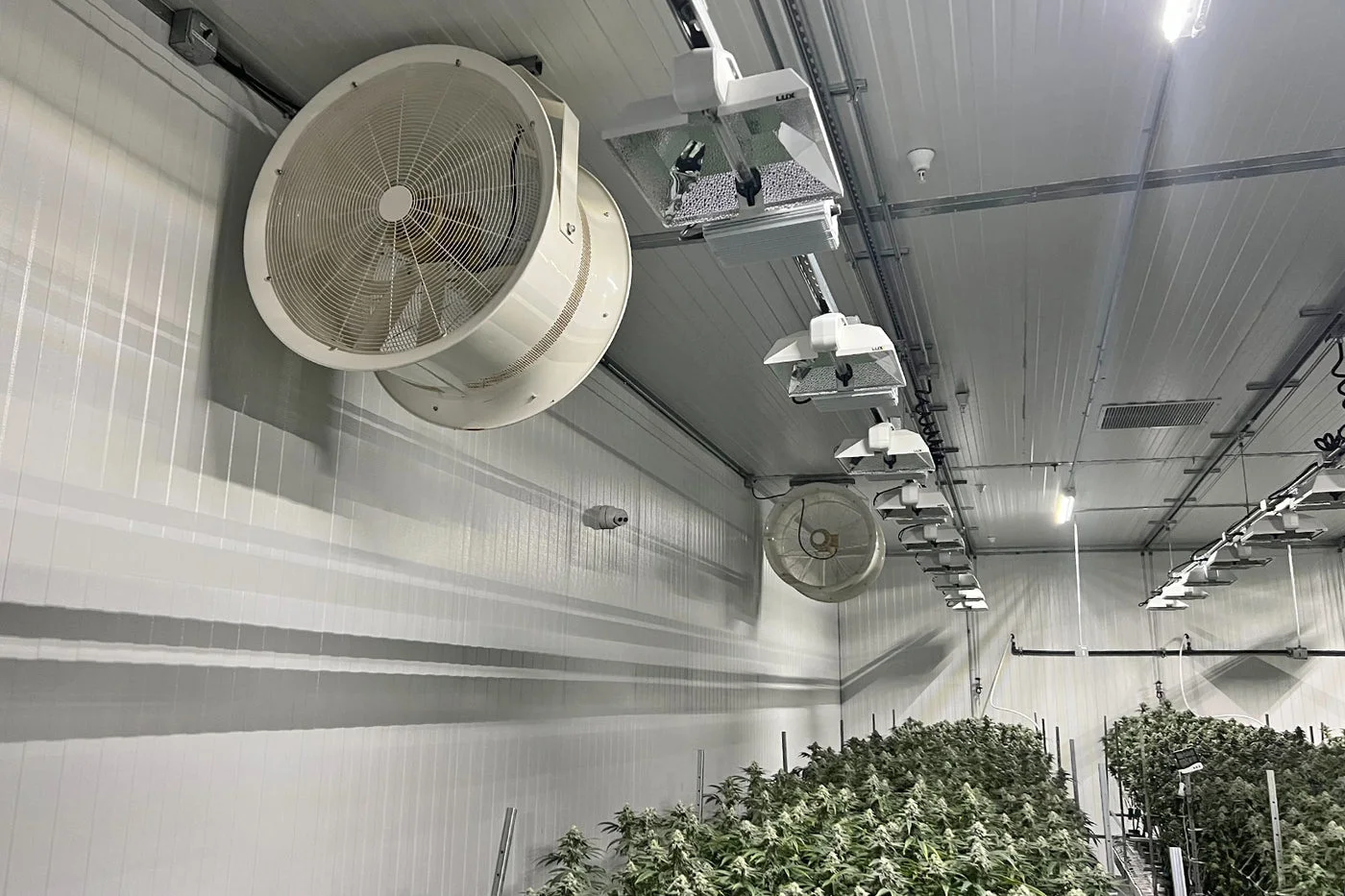
- Single-tier room up to the fan's throw in length: fans on opposite walls aimed in opposite directions, forming a simple oval loop. Mount at or a little above canopy height.
- Rooms longer than one throw: staggered racetrack on the long walls, with fans on each wall offset so their throws overlap mid-room.
- Two-tier racking: perimeter fans for the upper tier plus rack-mounted fans at the lower tier, aimed down each row.
- Three or more tiers: treat each tier as its own circulation zone with in-rack fans at each level.
- Irregular or obstructed rooms: split into rectangular zones at each obstruction and give each zone its own loop. Corners often need a dedicated fan.
Worked Example: Sizing Fans for a 6,000 sq ft Flower Room with Two-Tier Racking
Take a 60 ft × 100 ft flower room (6,000 sq ft) with two-tier racks in 10 rows. This is an illustration of the method; a real layout depends on where the racks, HVAC drops and doors are.
- Throw: the room is 100 ft long. The 22" fan's 100 ft throw reaches the far wall; an 18" (80 ft) would need a staggered racetrack on both long walls.
- Baseline: 6,000 ÷ 3,600 rated coverage = 1.67, so 2 × 22" fans on opposite walls to form the loop.
- Racking adjustment: perimeter fans won't reach the lower tier, so add one rack-mounted fan per row at the lower tier, aimed down the row: 10 × 14" fans with rack mounts.
- Canopy adjustment: if smoke pools mid-room in late flower, add a third perimeter fan to tighten the loop.
- Result: 2–3 × 22" perimeter fans plus 10 rack-level 14" fans, confirmed by smoke test and anemometer readings at each tier.
Frequently asked questions
Should I size circulation fans on room volume or floor area?
Can I run HAF fans 24/7, including the dark period?
How do I check airflow at canopy level?
Do circulation fans help with CO₂ supplementation?
How do I handle airflow in a trim room or dry room differently from a flower room?
What Fans Cannot Do: Setting Correct Expectations
Circulation fans are the distribution layer of your climate system, not the conditioning layer. A well-spec'd HAF array moves the air your dehumidifiers and HVAC have already treated to every corner of the canopy. It cannot remove moisture from the room — only dehumidification equipment does that. It cannot reduce temperature — only cooling does that. What it can do is ensure that the conditioned air those systems produce is actually experienced uniformly by every plant in the room rather than pooling near equipment outlets and leaving the room interior untreated. Operators who add fans to compensate for undersized dehumidification will see marginal improvements at best; the correct fix is always to address the root cause in the HVAC-D system first, then confirm circulation is distributing that capacity effectively.
Planning a build or an upgrade?
Hydro Supply Co. supplies commercial cultivators nationwide — lighting, climate, irrigation, nutrients and post-harvest, from one source.
Request a Quote