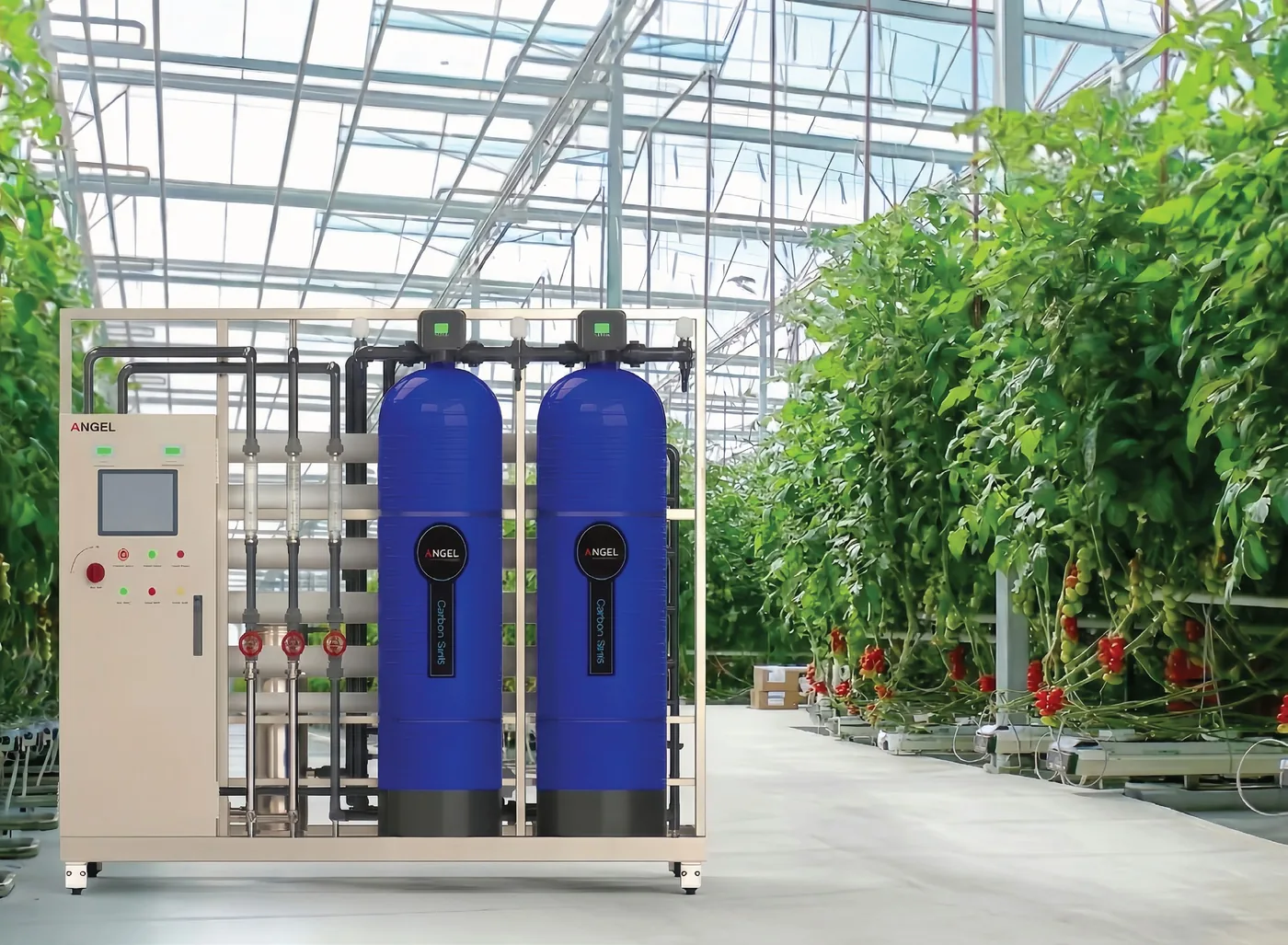
Selecting a commercial RO system for a grow room is not a plug-and-play decision. Get the capacity wrong and you starve your fertigation line during peak demand; over-specify and you're running a system that cycles on and off so fast it never reaches steady-state efficiency. This guide walks cultivation directors and facility engineers through every decision layer: when RO is justified by your source water, how to calculate peak daily demand with real numbers, how to account for temperature and TDS derating, concentrate math, storage sizing, pretreatment stack, and the maintenance intervals that determine how long your membranes last. Where system-specific data is shown, it references the commercial agriculture RO skids available through HSC — sized and matched to your water test and room layout.
When Is a Commercial RO System Worth It? Source-Water Decision Criteria
Not every facility needs RO. The decision hinges on four source-water variables that directly affect your nutrient program's precision and consistency. TDS above roughly 200 ppm starts introducing enough background calcium, magnesium, sulfate, and sodium to throw off a tightly calibrated feed recipe — especially in two-part or precision dry-salt programs where every ion is intentional. High alkalinity (bicarbonate as CaCO₃) means your pH buffer is a moving target across batches; RO strips it, giving you a neutral canvas that holds pH correction stably. Chloramine is the issue most commonly underestimated by operators switching from well water to municipal supply: unlike free chlorine, chloramine does not off-gas with time or aeration and requires active removal. It suppresses the beneficial bacteria and mycorrhizal fungi that organic and living-soil programs depend on. And water inconsistency — seasonal TDS swings from a municipal system or a well that draws from variable depths — makes batch-to-batch EC targeting unreliable without a fixed-purity baseline. See our deeper dive on water quality and irrigation uniformity in cannabis for the root-zone chemistry behind these decisions.
Calculating Peak Daily Water Demand for a Commercial RO System
Size RO capacity to total daily RO water demand, not to instantaneous flow. The system runs steadily to fill a storage tank, and the tank supplies the fertigation line on demand. That's what lets a 10,000 GPD skid serve an irrigation pump drawing far more per minute than the skid makes. The best input is your own metered data: flow meter or controller logs on your heaviest irrigation days. If you're building out, size from the irrigation plan for your canopy and media. On top of irrigation, add the demand categories that are easy to miss:
- Reservoir and batch-tank fills: If you mix nutrients in 500-gallon reservoirs or IBC totes and turn them over multiple times per week, that fill volume must be covered by your daily production. A 500-gallon batch twice per week adds ~143 gallons/day of average demand — and on fill days, it all hits at once.
- Straight-RO irrigation (drain-to-waste coco/rockwool): High-frequency drip on coco at 20–30% runoff targets means you're irrigating more total volume than the plant consumes. Factor runoff percentage into your gross irrigation volume, not just net uptake.
- Cleaning and sanitation: Line flushes, reservoir cleaning, and tool sanitation add incremental daily demand that operators routinely undercount. Budget 5–10% on top of irrigation and mixing totals.
Worked example: drain-to-waste coco, peak flower days.
Irrigation delivered (from controller logs, runoff included): 7,200 GPD
Batch-tank mixing (two 500-gal reservoirs filled daily): +1,000 GPD
Cleaning and sanitation, about 5%: +410 GPD
Peak daily demand: 8,610 GPD
Add a 20% margin for demand spikes, membrane ageing and cold feed water: 8,610 × 1.2 = 10,332 GPD minimum rated capacity. The ROS10 falls just short, so this facility lands on the ROS15 (15,000 GPD, 10 membranes), which also leaves room to grow.
Derating for Cold Feed Water and High Source TDS
Every membrane is rated at 77°F (25°C) and a clean feed at the manufacturer's specified test pressure. Real-world output diverges from that rating in two consistent ways that operators in northern facilities and well-water operations must account for before they finalize a skid size.
Temperature: RO membranes are rated at 77°F (25°C). Colder water is more viscous and passes through the membrane more slowly, so output falls as feed water cools, and the loss in winter can be substantial. A facility drawing cold well or municipal water for several months of the year should size with that in mind. The VFD-driven pump on the ANGEL skids holds operating pressure steady, but pressure can't fully make up for cold water. Ask us for the temperature correction against your coldest feed temperature, and insulate feed lines that run through cold space.
High TDS derating: The ROS agriculture skids are rated for feed water up to 1,000 ppm TDS (city or well supply). As feed TDS increases toward that ceiling, osmotic back-pressure rises and net permeate production per unit of applied pressure drops. A feed at 800 ppm will produce measurably less permeate per hour than the same skid running on 150 ppm municipal water, even at the same operating pressure. If your water panel comes back toward the high end of that range, size with extra headroom.
Recovery Ratio, Concentrate Math, and Drain Planning
Recovery ratio is the fraction of feed water that becomes usable permeate. The ROS agriculture skids are rated at 85%+ recovery — expressed as a 5:1 production-to-concentrate ratio — meaning for every 5 gallons of permeate produced, approximately 1 gallon goes to drain as concentrate. At that recovery rate, the concentrate math for a 10,000-GPD system is straightforward: you consume roughly 11,765 gallons of feed water per day to produce 10,000 gallons of permeate, sending ~1,765 gallons to drain.
That concentrate volume has two planning implications. First, drain capacity: your floor drain, mop sink, or sewer tie-in must be able to handle continuous low-flow concentrate discharge across the operating day. At 85% recovery, the continuous drain rate for a 10,000-GPD skid is approximately 1.22 GPM — modest, but it runs 24 hours. Second, concentrate quality: the reject stream carries everything the membrane rejected: several times the feed TDS, concentrated hardness, and any minerals that would otherwise scale the membrane surface. Never recirculate concentrate back to the feed tank without professional guidance; it drives up feed TDS, accelerates scaling, and pushes the system outside its design recovery envelope.
Storage Tank Sizing: Decoupling Production from Irrigation Demand
A commercial RO system that starts and stops constantly to chase irrigation demand is running outside its design envelope. Short cycling causes pressure hammer across the membrane stack, accelerates pump seal wear, and results in poor permeate quality during the startup transient before the system reaches steady-state operating pressure. The solution is a correctly sized buffer tank between the RO skid and your fertigation system. The storage tank should hold a minimum of 1.5× your peak single-day permeate demand — preferably 2× if you have room — so the RO unit runs at a continuous, moderate duty cycle rather than starting and stopping on irrigation events.
Using the worked example (8,610 GPD peak demand): 8,610 × 1.5 = about 13,000 gallons of storage. Running at 625 GPH, the ROS15 refills that from empty in about 21 hours. Set the tank float or level control so the RO starts refilling well before the tank is low and stops before it's full. With automated fertigation, wire the tank level into the irrigation controller (dry contact or 4–20 mA) so it never calls for water the tank can't supply. See our guide to fertigation automation and injectors for the integration side.
Pretreatment Stack: Protecting the Membranes That Drive the System
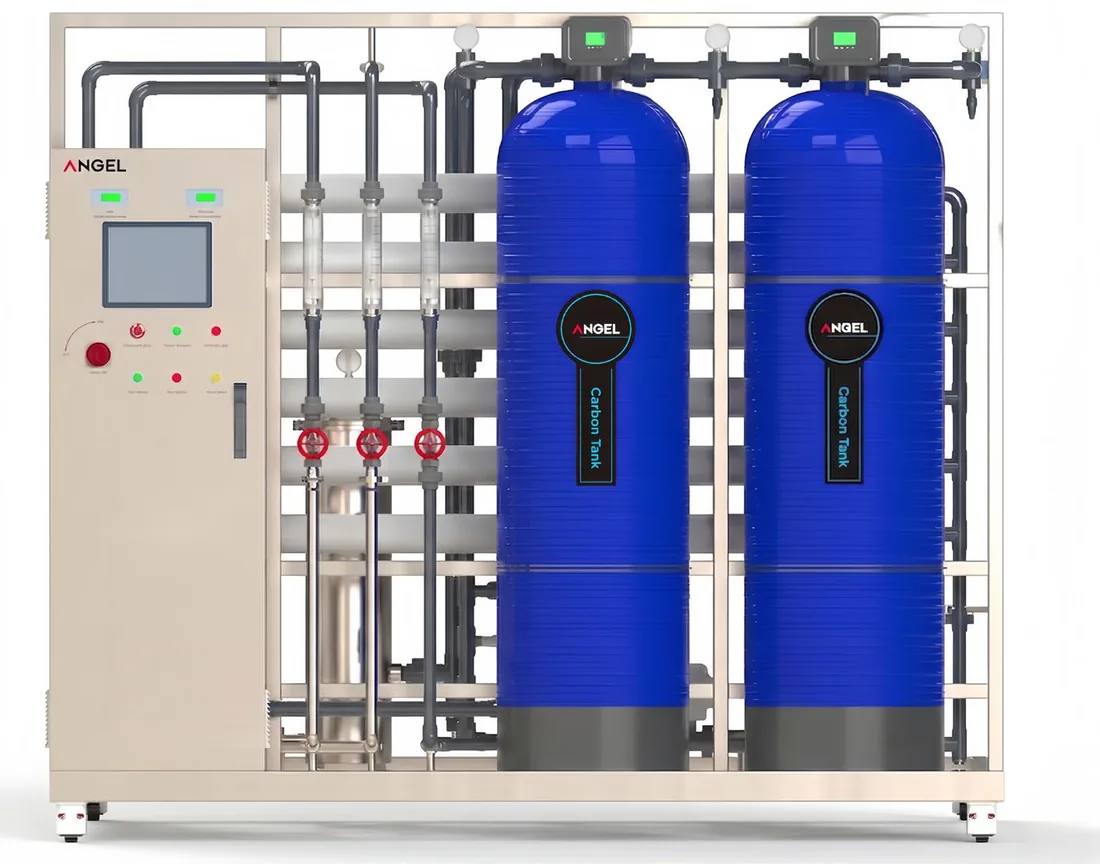
The membrane is the most expensive serviceable component on any RO skid. Pretreatment is what decides how long it lasts. The ROS agriculture skids arrive with a complete on-frame pretreatment stack: dual pre-filled GAC tanks with auto-backwash, an antiscalant injection system (no salt softener required), a sediment tank, and a 5-micron security filter immediately ahead of the high-pressure pump. Here's what each stage is doing and why it matters.
- Sediment tank and 5 µm security filter: catch sand, rust, pipe scale and biofilm fragments before they reach the carbon or the membranes. The 5 micron security filter right before the high-pressure pump is the last barrier.
- Dual GAC tanks with automatic backwash: remove chlorine and chloramine. Polyamide thin-film membranes, the industry standard, are damaged by continuous chlorine exposure, and chloramine doesn't off-gas, so it has to be removed by carbon. Automatic backwash keeps the beds working without hands-on maintenance. For well water with iron, manganese or sulfur, the first GAC tank can be swapped for greensand, used with the built-in oxidation injection port.
- Antiscalant injection (no salt softener): rather than swapping hardness for sodium the way a softener does, antiscalant keeps scale-forming minerals from crystallising on the membrane so they leave in the concentrate. That avoids adding sodium to the feed, which matters for nutrient programs sensitive to it.
Skid Selection: ROS5 Through ROS20 for Commercial Grow Operations
The ANGEL agriculture RO series covers the GPD range relevant to licensed cannabis and hemp operations — from single-room craft facilities to multi-room production buildings. All models share the same operating parameters: up to 99% TDS removal, up to 85%+ recovery (5:1 production-to-concentrate), feed water under 1,000 ppm TDS, inlet pressure 15–58 psi, operating pressure 115–175 psi, feed temperature 41–113°F, three-phase 240V 60 Hz power, and a 9-inch Siemens touchscreen with permeate TDS alarm, low-pressure auto-restart, and permeate flush on shutdown. Match skid to your demand-plus-derating calculation, not to your demand alone.
The last column is rated output ÷ 1.2: the peak daily demand each skid covers with the 20% margin from the worked example. Cold feed water or high TDS pushes you toward the next size up. Each model has its own page with dimensions, weights and connections in the ANGEL range.
Site Requirements and Membrane Maintenance Intervals
Site requirements to plan before equipment arrives: Three-phase 240V 60 Hz service sized for the skid's motor load plus an NEC code-required service factor. A floor drain or sewer connection capable of handling continuous concentrate flow (at 85% recovery, plan for ~20% of your feed flow rate). Adequate feed-line pressure — the ROS skids accept 15–58 psi inlet, so most municipal services connect directly; some well systems will need a booster. The skid footprint scales with membrane count; confirm floor space and ceiling clearance before delivery. Insulated or climate-controlled plumbing on the feed line if your facility or utility room drops below 50°F in winter.
Membrane and filter maintenance: With good pretreatment and regular monitoring, membranes last for years; without it they foul or scale early. The primary serviceable components on the ROS skids are the RO-4040 ultra-low-pressure membranes (99.5% rejection, standard 4040 housing format) and the 5-micron sediment filters (2"×30" and 2"×20" formats). Log daily operating parameters — feed pressure, permeate pressure, concentrate pressure, feed EC, permeate EC, feed temperature, and permeate flow rate. A sustained drop in normalized permeate flow, or rising permeate TDS at steady feed TDS, is the signal to initiate a clean-in-place (CIP) cycle before damage becomes irreversible. The Siemens touchscreen with permeate TDS alarm provides the continuous permeate monitoring needed to catch membrane degradation early. Check the sediment filters on a schedule set by your source water; dirtier water means more frequent changes. GAC backwash runs automatically.
Frequently asked questions
What source-water TDS level makes RO necessary for a commercial cannabis grow?
Can I run my fertigation injectors directly off the RO unit without a storage tank?
What happens to my RO output in winter when feed water gets cold?
Does the antiscalant injection system replace a water softener?
How do I know when my RO membranes need cleaning or replacement?
Planning a build or an upgrade?
Hydro Supply Co. supplies commercial cultivators nationwide — lighting, climate, irrigation, nutrients and post-harvest, from one source.
Request a Quote